

How to choose between a safety consultant, part-time support, fractional safety leadership and a full-time hire
“Do we need to hire a safety manager?” sounds like a yes-or-no question.
Your company may need help with one project, regular safety leadership, temporary field coverage or a full-time employee. The challenge is that terms such as contract safety, part-time safety and fractional safety are often used interchangeably.
The right starting point is not a job title. It is understanding what work needs to be done, how often it needs to happen, where it needs to happen and whether anyone internally has the time and experience to own it.
Not sure where your company fits?
Take the free BVS Fractional Safety Quiz to see whether you may need a few internal improvements, ongoing support or a full-time safety hire.
“Do We Need a Safety Person?” May Be the Wrong Question
Most companies do not reach one obvious moment when they suddenly need a safety professional.
Safety may be assigned to a project manager, HR professional or supervisor who already has a full workload. Documents get updated when a client asks for them. Corrective actions are identified, but follow-up is inconsistent. An audit, prequalification request or new project creates a last-minute scramble.
Safety is becoming reactive.
The better question is:
What level of support would give our safety program consistent ownership?
For some companies, the answer is a defined consulting project. For others, it is a professional who works with the business a few hours or days each month. More complex operations may require regular onsite coverage or a full-time employee.
The goal is not to hire the biggest solution. It is to choose the option that closes the gap.
Why the Terminology Is Confusing
These terms describe different parts of the working relationship:
- A contract safety professional is an external provider rather than an employee.
- A part-time safety professional provides a limited number of hours or days.
- Onsite safety support describes where the work happens.
- A safety consultant often provides expertise for a specific issue or project.
- A fractional safety leader provides ongoing leadership for a defined portion of the time.
- A full-time safety manager is an employee who manages a continuous daily workload.
One person can be contracted, part-time, fractional and onsite at the same time. A company might retain an external professional for two days each month, with one day spent onsite and the remaining time used for administration, follow-up and management guidance.
“Contract” describes how the person is engaged. “Part-time” describes how much they work. “Onsite” describes where they work. “Fractional” describes the ongoing leadership role they provide.
Part-Time and Fractional Are Not Always the Same
Part-time mainly describes hours. A part-time professional might conduct inspections, organize records, update documents or support a project.
Fractional safety describes the function. A fractional professional usually helps management set priorities, monitor required activities and keep the overall program moving.
They are not only waiting for a task list. They help determine what belongs on the list, what should happen first and who needs to follow through.
This matters when safety is spread across several busy people. Your company may not need another person completing isolated assignments. You may need someone to create consistency, coordination and accountability.
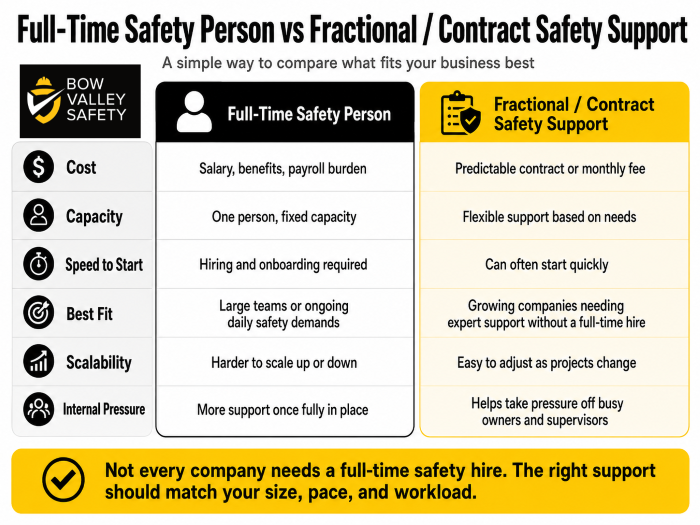 Which Type of Support Fits Your Situation?
Occasional or project-based consulting
This may be enough when your program is generally functioning and someone internally can manage it. You may need a policy review, help interpreting a client requirement, a gap assessment, audit preparation, an investigation or a program update.
Project-based work is most effective when the objective has a clear beginning and end—and someone can maintain the result after the consultant leaves.
Fractional safety leadership
This may be the right fit when responsibilities recur every week or month, but the workload does not justify a full-time position.
A fractional professional can provide regular leadership on a weekly, biweekly or monthly basis. The scope may include program management, document control, corrective-action tracking, supervisor coaching, incident review and planning for upcoming work.
This model is especially useful when safety activity exists, but ownership and follow-through are inconsistent.
Part-time onsite support
This may be appropriate when the largest gap is in the field. Supervisors may need coaching, inspections may be inconsistent or conditions may change frequently.
Onsite support can be combined with fractional leadership. A professional might manage the program remotely while visiting active sites at agreed intervals.
Temporary contract coverage
A project can create a short-term increase in safety demands. A client may require dedicated coverage, several contractors may be working together or an internal team member may be overloaded.
Contract support adds capacity without creating a permanent role after the project ends.
A full-time safety hire
A full-time employee may be appropriate when safety has become a substantial daily function. This is more likely with multiple active sites, a larger workforce, complex operations or continuous training, reporting and field-support needs.
Fractional support should not be used to squeeze a full-time workload into a few hours each month. The scope must remain realistic.
Five Questions to Help You Choose
1. Is the work one-time or recurring?
A defined deliverable points toward project consulting. Responsibilities that return every week or month point toward ongoing support.
2. How much field presence is required?
Some work can be managed through remote support, meetings and scheduled site visits. Changing conditions, multiple crews or significant field coordination may require more onsite coverage.
3. Is there a capable internal owner with enough time?
Having someone’s name beside “safety” does not mean they have capacity. A project manager may understand the program but still need to prioritize clients, schedules and budgets. The problem is often not commitment. It is bandwidth.
4. Are you proactive or reacting to deadlines?
Are documents reviewed regularly, or updated because a client needs them tomorrow? Are corrective actions tracked to completion, or rediscovered during the next inspection?
Regular scrambling points to a capacity, ownership or system gap.
5. Is there enough work for a full-time position?
Some companies need more than occasional advice but cannot justify a full-time role. That is often the fractional-safety sweet spot: consistent access to experienced support without creating a permanent position too early.
Do several of these situations sound familiar?
Take the BVS Fractional Safety Quiz to identify where your current approach is working and where support may help.
[Take the Free Quiz]
What Does a Fractional Safety Professional Actually Do?
The scope should reflect your priorities. A fractional professional may:
- Establish monthly or quarterly priorities
- Review inspections, meetings and training
- Maintain policies, forms and procedures
- Track incidents, hazards and corrective actions
- Coach supervisors
- Prepare for audits, client reviews or prequalification
- Coordinate site visits
- Give management a clear view of what needs attention
The role creates a regular process for setting priorities, assigning actions and checking progress rather than addressing safety only when a deadline or problem appears.
External support does not remove the responsibilities of owners, managers or supervisors. A productive relationship is a partnership: the safety professional provides expertise, coordination and accountability, while company leadership supports the process and carries expectations into daily operations.
Three Examples of Right-Sized Support
The growing contractor
A project manager is responsible for safety in addition to clients, schedules and subcontractors. Documents are updated before audits, inspections are inconsistent and follow-up is difficult.
Fractional leadership with scheduled site visits may be a good fit.
The company beginning a major project
The business has an established safety program, but a large project introduces new workers, several subcontractors and additional client requirements.
Temporary onsite contract support may be more appropriate than a permanent hire.
The established multi-site company
The company has several locations, frequent onboarding and a substantial daily field workload.
A full-time internal professional may now be the right choice, with BVS supporting specialized projects, audits or temporary overflow.
The right answer is not always fractional safety. A credible provider should help identify the support you actually need, even when that means recommending a full-time hire.
Not Sure What to Do Next?
You do not need to choose a job title or write a complete scope before asking for help. Start by identifying the gap.
Step 1: Take the free quiz
Use the BVS Fractional Safety Quiz to consider whether your company needs internal improvements, ongoing support or a full-time role.
[Take the Free Fractional Safety Quiz]
Step 2: Book a free safety call
Already dealing with an audit, client request, active project or growing backlog? Talk it through with BVS and identify the level of support that makes sense.
Step 3: Put the right support in place
BVS can develop a practical scope that may include fractional leadership, field support, inspections, document management, supervisor coaching or a defined consulting project.
The best solution is not necessarily the largest or most expensive. It is the one that gives your safety program clear ownership, consistent follow-through and enough support to keep pace with your business.